Japan shelled California and Oregon in 1942, and the pilot who bombed Oregon’s woods later gave the town his sword
Most people assume World War II never reached the mainland West Coast. It did, more than once, and the proof is still sitting on a California beach path, an Oregon gun battery and a bomb crater deep in the southern Oregon woods.
December 7 marks 85 years since Pearl Harbor, so this is the month to go find them. None of these stops needs more than a short walk, and one comes with the strangest peace offering you’ll ever see in a small-town library.
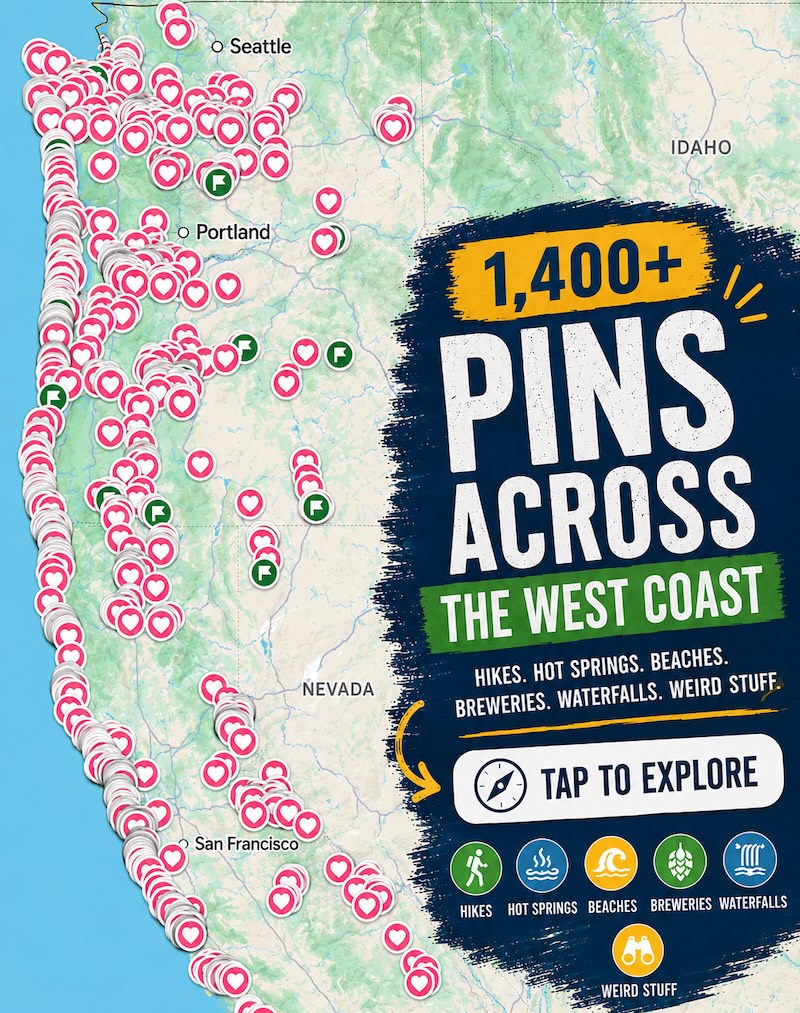
Psst, we made you a West Coast Adventure Map. Nearly 1,900 of our favorite spots, already pinned, ready to load into Google Maps in two clicks: grab it here.
Ellwood, California: the first shells, February 1942
On the evening of February 23, 1942, a Japanese submarine called I-17 surfaced off the Ellwood oil field near Goleta, about 10 miles up the coast from Santa Barbara. Around 7 p.m. its crew started firing the deck gun at the oil facilities on shore.
📍 GET THE ULTIMATE PNW MAP 🗺️
Get our curated list of the best adventures, things to do, and places to grab a brew loaded onto your maps with just two clicks!
✅ Waterfalls ✅ Hikes ✅ Viewpoints
✅ Craft breweries ✅ National Parks ✅ 1400+ Pins

The timing was almost theatrical: President Roosevelt was in the middle of a radio fireside chat. It was the first time a foreign power had shelled the U.S. mainland since the War of 1812, though most of the rounds missed and the damage was later estimated at about $500.
The old oil field is a golf course now, with a bronze plaque on the grounds. The easier stop is the historical society marker along the public walkway down to Haskell’s Beach, below the Ritz-Carlton Bacara. Go late in the day, look out at the calm water where the sub sat, and try to picture the panic.
Fort Stevens, Oregon: the only military base hit, June 1942
Four months later, a different submarine, I-25, trailed a fleet of fishing boats past the minefields at the mouth of the Columbia River. Late on the night of June 21, it opened fire on Battery Russell at Fort Stevens.
Nobody agrees on the exact count. Most accounts say 17 shells, while the Army said nine at the time. Either way, they mostly landed in a swamp and on the post’s baseball field, and the fort’s guns never fired back, partly because the sub was thought to be out of range.
That makes Fort Stevens the only military installation in the lower 48 attacked by the Axis during the war. Today it’s Fort Stevens State Park, the concrete bunkers of Battery Russell are still standing, and a stone monument to the attack sits just south of them.
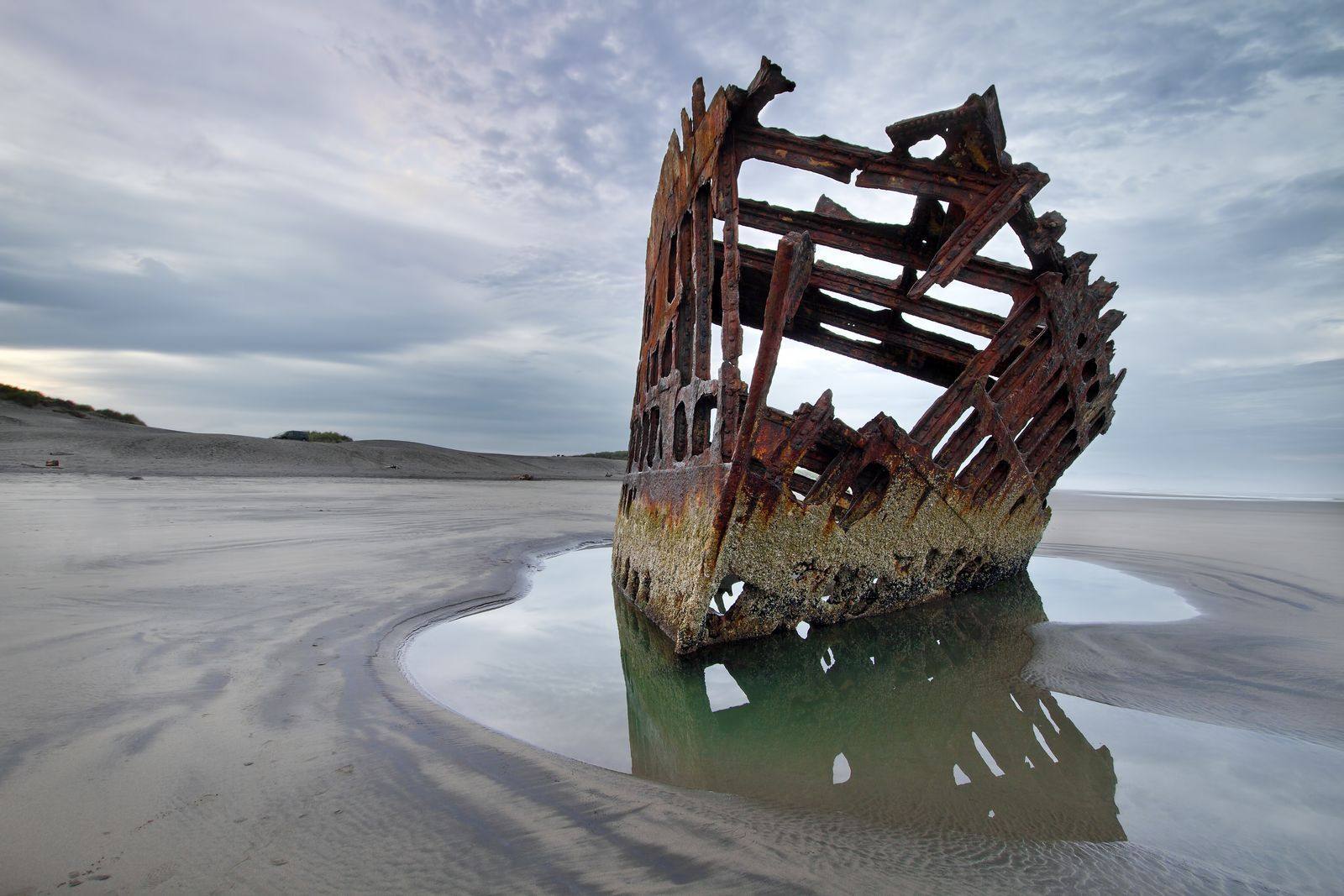
Day-use parking costs $10 for Oregon residents and $12 for everyone else. While you’re there, walk out to the rusting Peter Iredale shipwreck on the beach. Gray winter skies suit both stops perfectly.
Brookings, Oregon: the only bombs dropped from a plane, September 1942
Here’s the one that sounds made up. On September 9, 1942, that same I-25 surfaced off the southern Oregon coast and launched a small floatplane from its deck, flown by a pilot named Nobuo Fujita.
Fujita dropped two incendiary bombs, hoping to set the forest on fire, and one landed on Wheeler Ridge on the slopes of Mount Emily. It started a small blaze roughly 10 miles east of Brookings as the crow flies, and fire lookouts got it under control. It was the first time an enemy aircraft had bombed the U.S. mainland.
The twist? Twenty years later, in 1962, Fujita came back to Brookings and handed the town his family’s 400-year-old samurai sword as a gesture of peace. He returned several more times, planted a redwood at the bomb site in 1992, and was made an honorary citizen shortly before he died in 1997.

The sword is on display in the Chetco Community Public Library at 405 Alder St., with a plaque calling him “the only enemy to bomb the U.S. from the air.” It’s free to see and only takes a few minutes. Don’t skip it.
For the real thing, Bombsite Trail #1118 sits about 19 miles east of town by road, reached via County Road 808 and Forest Road 1205. It’s about a mile on a narrow dirt path with some ups and downs, ending at the crater and that 1992 redwood, now an Oregon Heritage Tree. Winter rain is hard on these remote forest roads, so call the Chetco Ranger District for current conditions before you drive out.
Brookings sits just north of the California line, and it’s worth a night on its own. Our guide to the best Oregon coast towns has what to do once you’re there.
Bly, Oregon: the only deaths, May 1945
Between November 1944 and April 1945, Japan launched roughly 9,000 paper balloon bombs to drift across the Pacific. Most did nothing. One did not.
On May 5, 1945, a Bly pastor named Archie Mitchell took his pregnant wife, Elsie, and five kids from his Sunday school class on a picnic near Gearhart Mountain. While he parked the car, the group found a balloon bomb in the woods and it exploded, killing all six. They’re the only people killed by enemy action on the continental U.S. during the war.
The Mitchell Monument, dedicated in 1950, stands at a small picnic area in the Fremont-Winema National Forest, about 30 minutes northeast of Bly via Highway 140 and Campbell Road. A ponderosa pine beside it still carries shrapnel scars and was named an Oregon Heritage Tree in 2005.
Of the four, this is the one that stays with you. Decades later, Japanese women who had built the balloons folded 1,000 paper cranes for the families and came to visit the site. It’s high, remote country, so check road conditions with the Bly Ranger District before going in winter.
Turn it into a road trip
Fort Stevens and Brookings sit at opposite ends of the Oregon coast, so Highway 101 links them in one long, gorgeous drive. Start up north with a night in Astoria, then work your way south.
If you only have time for one stop, make it Brookings. You get the sword, the trail and the crater in a single day, and the story behind them is the best one on this list.
Trip tips: grab a rental car to get out here, lock in your hotel before the good rooms are gone, or skip both and book a camper van instead.
Had you heard about any of these before? Tell us which one surprised you most, and whether you’d make the drive out to the Brookings crater.
Rules and fees change, so always confirm current requirements before you go.