Best Van Life & Road Trip Spots on the West Coast
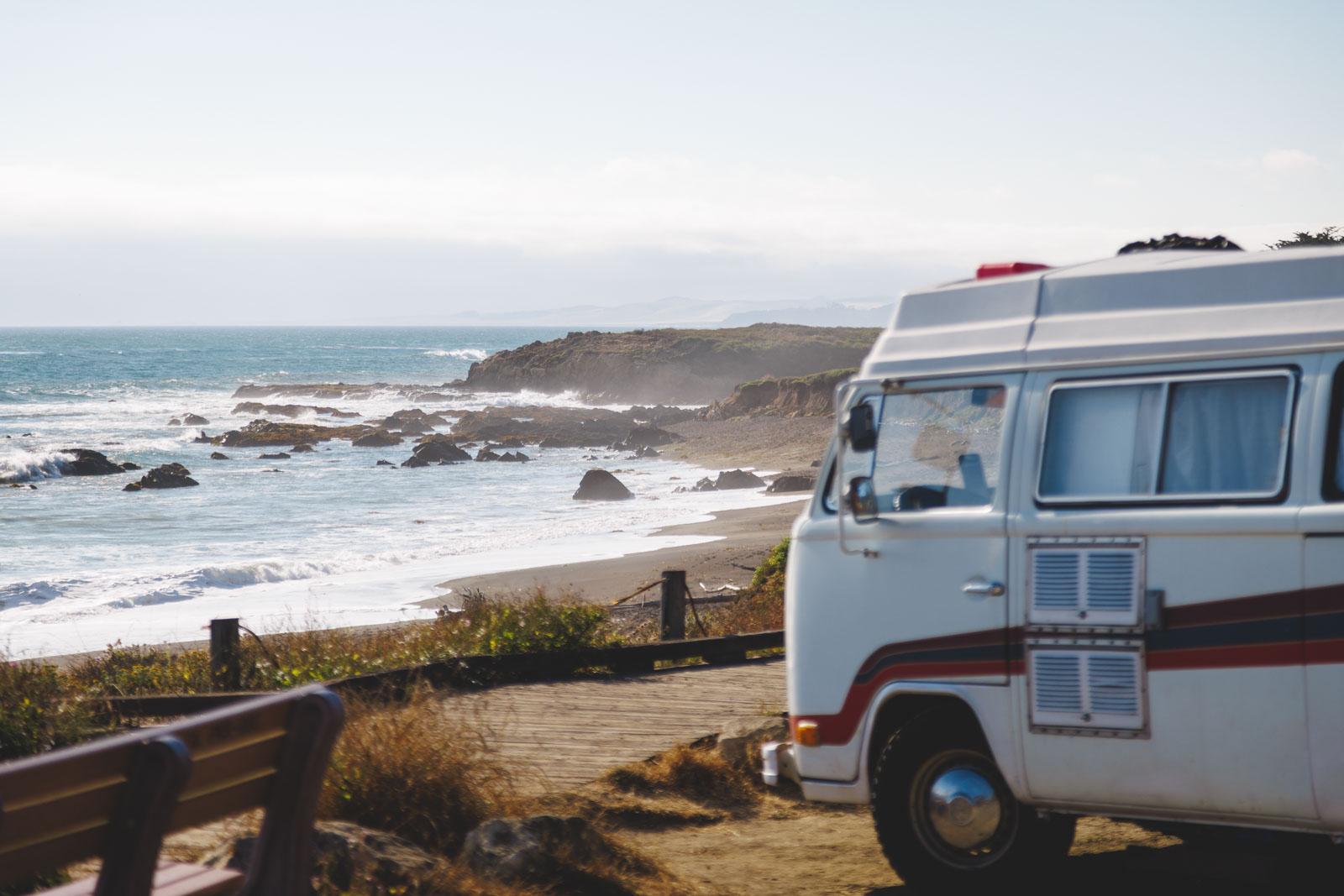
If you’ve been around here for a while, you know we do a lot of our exploring in Lucy — our 1974 VW Bus. She’s slow, she’s loud, she breaks down occasionally, and she is absolutely the best way to see the West Coast. There’s something about road tripping in a van that just changes how you experience a place. You stop more. You stay longer. You end up somewhere you never planned to be, and it turns out to be the best part of the trip.
The West Coast is van life central for good reason. Over 1,500 miles of coastline, ancient forests, volcanic peaks, desert basins, alpine lakes, and enough free and low-cost camping to keep you moving for months without breaking the bank.
Here are the best van life and road trip spots on the West Coast — organized by region, with practical info on where to sleep, what to do, and why each one deserves a spot on your route.
Washington
Olympic Peninsula — The Big Loop
The Olympic Peninsula is one of the greatest van life destinations in North America. Temperate rainforest, rugged Pacific coastline, glacier-carved lakes, and one of the most dramatic national parks in the country — all connected by a loop road (Highway 101) that you could drive in a day but shouldn’t take less than a week.
📍 GET THE ULTIMATE PNW MAP 🗺️
Get our curated list of the best adventures, things to do, and places to grab a brew loaded onto your maps with just two clicks!
✅ Waterfalls ✅ Hikes ✅ Viewpoints
✅ Craft breweries ✅ National Parks ✅ 1400+ Pins

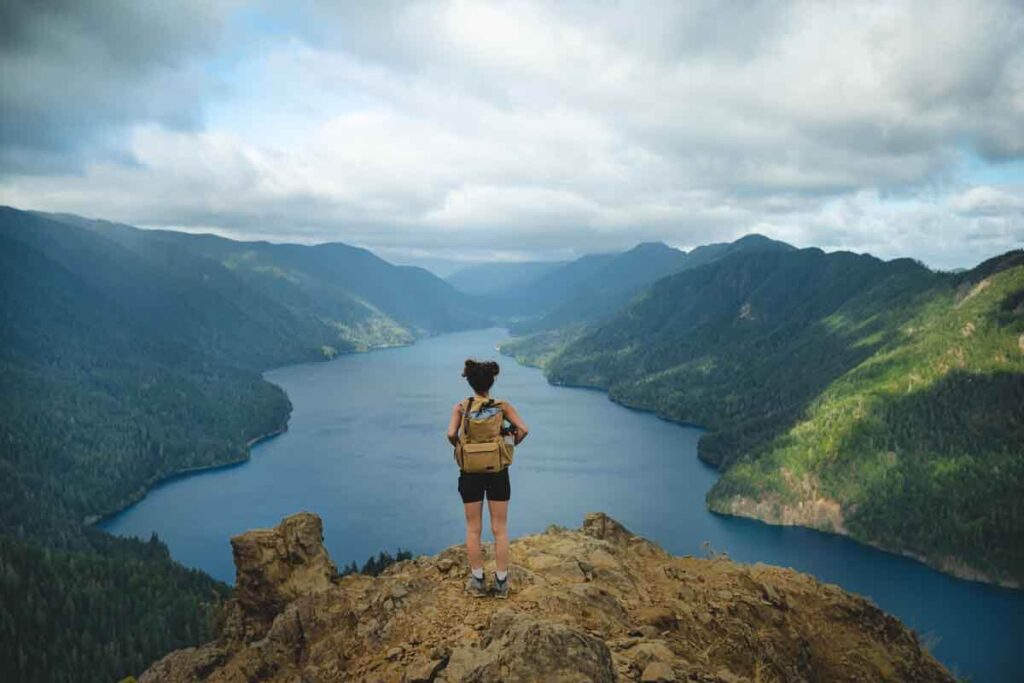
Lake Crescent for an impossibly clear alpine lake swim. Rialto Beach and Hole in the Wall for dramatic coastal hiking. The Hoh Rain Forest for ancient old-growth moss that makes you feel like you’ve left the planet. Kalaloch Beach for camping right on the Pacific with waves crashing outside your van door.
Where to camp: Kalaloch Campground (right on the ocean), Sol Duc Campground (old-growth forest, near the hot springs), Fairholme Campground on Lake Crescent. All reservable on recreation.gov — book months ahead in summer.
Free camping: Dispersed camping allowed in the Olympic National Forest sections outside the park boundary. Check Olympic National Forest maps for current open areas.
North Cascades — Mountains & Alpine Lakes
The North Cascades are arguably the most dramatic mountain scenery in the contiguous United States — jagged peaks, hanging glaciers, turquoise rivers, and virtually zero crowds compared to the more famous national parks to the south.
Highway 20 (the North Cascades Highway) is one of the best scenic drives on the entire West Coast — open late April through mid-November, it winds through the Cascade passes with pullouts and trailheads every few miles. The Chain Lakes Loop near Mt. Baker is one of the greatest day hikes in Washington.
Where to camp: Colonial Creek Campground and Goodell Creek Campground along Highway 20. Dispersed camping allowed throughout Okanogan-Wenatchee National Forest — free, first come first served, no hookups.
Van life tip: Cell service disappears completely in the Cascades. Download offline maps before you leave Marysville or Sedro-Woolley going east.
Leavenworth & the Wenatchee River Valley
Leavenworth is the Bavarian village in the Cascades that sounds ridiculous until you’re actually there, at which point it’s completely charming. Great base for hiking, rock climbing, river floating, and some of the best trails in Washington.
The Wenatchee River running through the valley is excellent for kayaking and floating in summer. Tumwater Campground just down the road is a solid, affordable base camp with river access.
Where to camp: Tumwater Campground (Okanogan-Wenatchee National Forest, $18/night, reservable). Free dispersed camping in the Cle Elum area around Salmon La Sac — right along the river, first-come-first-served.

Oregon
The Oregon Coast — Highway 101
The Oregon Coast is the quintessential West Coast van life route. 363 miles of Highway 101 from Astoria to the California border, with state parks, beach access, fishing towns, lighthouses, sea stacks, and campgrounds spaced almost perfectly for multi-day travel.
Some of the highlights: Cannon Beach for Haystack Rock and a genuinely great coastal town. Cape Perpetua for Thor’s Well and the most dramatic coastal scenery on the Oregon coast. Samuel H. Boardman Scenic Corridor near Brookings for the most photogenic stretch of the entire coast. Bandon Beach for sea stacks, great food, and a laid-back fishing town vibe.
Where to camp: Oregon State Parks run excellent campgrounds at almost every major stop — Beverly Beach, Cape Lookout, Bullards Beach, Harris Beach. Around $25–32/night for full hookups, less for tent sites. Reserve at reserveamerica.com. Most have yurts if you want a step up from sleeping in the van.
Van life tip: Dispersed camping is essentially impossible on the Oregon Coast — it’s one of the most restricted stretches on the West Coast for free camping. Budget for campground fees or stay just inland in the Coast Range where free forest service camping opens up.
Bend & Central Oregon — Desert Meets Cascades
Bend is the van life capital of Oregon — a city genuinely built around outdoor adventure, with a thriving brewpub scene to rehydrate after the trail. Smith Rock State Park for world-class rock climbing and hiking. The Cascade Lakes for alpine lake swims with volcanic peaks in the background. Proxy Falls for a jaw-dropping waterfall that’s weirdly accessible.

Central Oregon is also where you start finding genuinely excellent free camping again — Deschutes National Forest has dispersed camping throughout, and the high desert east of Bend opens up into wide-open BLM land.
Where to camp: Free dispersed camping throughout Deschutes National Forest (14-day limit, no facilities). Tumalo State Park near Bend for developed camping with a great river swimming hole. McKenzie Bridge Campground for old-growth forest camping on the McKenzie River.
Eastern Oregon — The Off-Grid Frontier
Eastern Oregon is the most underrated van life destination in the Pacific Northwest. Owyhee Canyonlands, Steens Mountain, the Alvord Desert, Malheur Wildlife Refuge — it’s vast, it’s remote, it’s staggeringly beautiful, and it’s almost entirely free BLM land where you can pull off almost anywhere and camp.
Steens Mountain is a 9,700-foot fault block mountain rising from the high desert with a summit road (the highest road in Oregon) and views across the Great Basin. The Alvord Desert at its base is a dry lake bed so flat you can see the curvature of the Earth on a clear day. Camp out there for free and the stargazing is legitimately world-class.
Where to camp: Almost entirely free BLM dispersed camping. Steens Mountain has developed BLM campgrounds at Page Springs and Fish Lake for a small fee. Cell service: essentially zero. Download everything before you leave Burns.
Van life tip: Eastern Oregon requires self-sufficiency — carry extra water, food, and a basic tool kit. The distances between services are real. Lucy has broken down in worse places.
Northern California
Redwood Country — Highway 101 & Avenue of the Giants
The Northern California redwood corridor is one of the most awe-inspiring drives on the West Coast and a van life experience unlike anything else. Ancient coastal redwoods so large they block out the sun, misty forest roads, and small towns that feel like the world hasn’t reached them yet.
The Avenue of the Giants is 31 miles of old-growth redwoods running alongside Highway 101 — go slow, stop constantly. Prairie Creek Redwoods State Park has Fern Canyon — a slot canyon dripping with ferns that appears in Jurassic Park and is just as surreal in person. Jedediah Smith Redwoods near Crescent City has the most pristine old-growth grove in California.
Where to camp: Jedediah Smith Campground (under the trees, right on the Smith River — one of the best campgrounds in California). Burlington and Hidden Springs Campgrounds along the Avenue of the Giants. Fees around $35/night — worth every penny for the setting.
Eastern Sierra — Highway 395
Highway 395 through the Eastern Sierra is the greatest van life road in California. Volcanic tablelands, ghost towns, natural hot springs, ancient bristlecone pines, and a wall of granite Cascade peaks to the west that makes every pullout feel cinematic.
Mono Lake for the eerie tufa towers. June Lake Loop for alpine lakes and small-town vibes. Hilltop Hot Springs near Mammoth for a free natural soak after a day on the trail. Crowley Lake Columns for volcanic formations that look completely unreal.

Where to camp: Free dispersed camping throughout Inyo National Forest — arguably the best free camping on the West Coast. Pull off almost anywhere with a forest service road, 14-day limit. The Alabama Hills near Lone Pine (BLM land) allows free camping with a permit and some of the most dramatic desert-meets-mountains scenery you’ve ever seen.
Van life tip: The Alabama Hills are genuinely one of the great free camping spots in the US — what to know before you visit.
Big Sur — Highway 1
Big Sur is the iconic one. Coastal cliffs dropping straight into the Pacific, redwood canyons, waterfalls like McWay Falls pouring onto a private beach, and a stretch of Highway 1 so dramatic it barely seems real.
It’s not easy van life — campgrounds book out months ahead, the road is winding and slow, and the area is wildly popular. But the reward is proportional. There is nowhere else on the West Coast that looks like Big Sur.
Where to camp: Pfeiffer Big Sur State Park and Kirk Creek Campground are the most coveted spots — book recreation.gov the day reservations open (typically 6 months in advance for summer). Los Padres National Forest has dispersed camping accessible via dirt forest roads inland — a good backup if developed sites are full.
Van Life Essentials for the West Coast
Apps worth downloading:
- iOverlander and The Dyrt for user-reported free and cheap camping spots
- Gaia GPS for offline maps and public land boundaries
- recreation.gov for reservable campgrounds — book early, summer dates go fast
The 14-day rule. Most BLM and National Forest dispersed camping has a 14-day limit per location before you need to move at least 25 miles. Follow it — rangers do check.
Leave No Trace. Free camping only stays free because people treat the land right. Pack everything out, use a wag bag or dig cat holes 200 feet from water, don’t leave fire rings. The spots that get trashed get closed.
Water. The West Coast has long stretches — especially in Eastern Oregon and the Eastern Sierra — where water is scarce. Carry at least 5 gallons of freshwater at all times. A Sawyer filter or Lifestraw is insurance.
Cell service reality: Gone in Olympic Peninsula forest, North Cascades, Eastern Oregon, and parts of the Sierra. Download everything before you enter. Tell someone your route.
More West Coast Road Tripping
For more inspiration, check out our West Coast road trips guide, the Oregon Coast road trip itinerary, and the best hikes in the PNW to fill out your route.
See you on the road, friend!